
Leak Detection • Miramar, FL
How to Tell If You Have a Slab Leak in Miramar
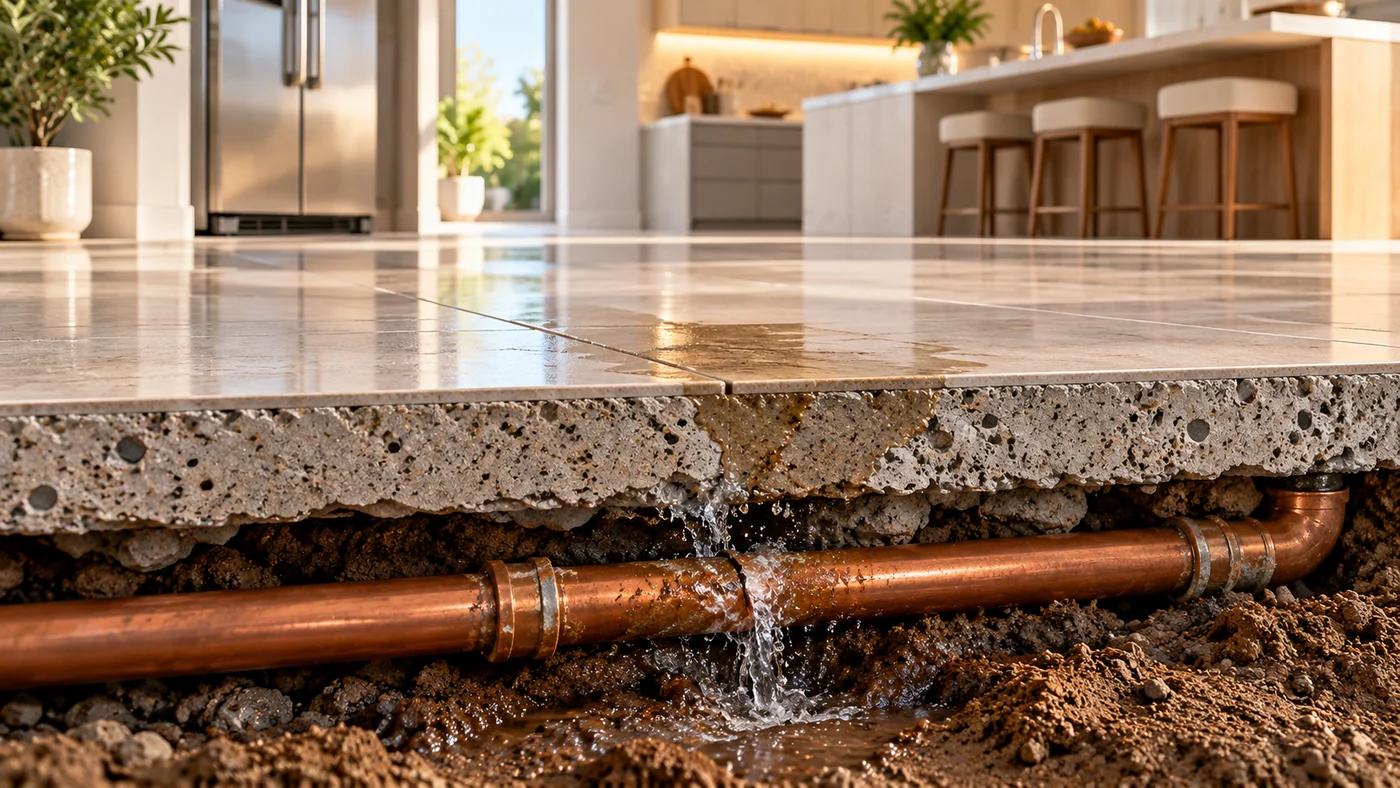
A slab leak is a break in a water line running underneath the concrete floor of your house. It does not drip where you can see it. By the time it shows itself, it has usually been running for weeks.

Most houses in Miramar are built on a concrete slab poured directly on grade, with the water supply lines running inside or underneath it. When one of those lines fails, the water has nowhere to go but sideways — through the soil, under the floor, and eventually up through the slab itself.
That is why a slab leak may not announce itself with a puddle. It announces itself with a water bill, a warm patch of tile, or a sound you cannot place.
What a slab leak actually is
A slab leak is a break in a pressurized water line below the floor slab. It is not a drain problem and it is not groundwater. Two kinds exist and they behave differently:
The hot water line fails. This is the more common of the two, because hot water accelerates corrosion and the pipe expands and contracts against the concrete every time someone showers. It produces the classic warm spot on the floor.
The cold line fails. Harder to notice because there is no temperature clue. Usually found through the water bill, the sound of running water, or a pressure drop.
Either one is losing water continuously, twenty-four hours a day, at system pressure. A leak the size of a pinhole can move several hundred gallons a week.
Three ways a water line can fail
The hot-versus-cold distinction describes which line is leaking. These are common ways the line itself may be damaged. Only an inspection can identify the cause in your home.
The six signs, in the order people notice them
1. The water bill jumps with no change in use
This is the single most common way a slab leak gets caught. Nothing changed in the house — same number of people, same habits — and the bill goes up by a third or doubles. A bill that climbs two months in a row is worth taking seriously even if nothing else is wrong.
2. A warm or hot spot on the floor
Walk the house barefoot, early in the morning, before anyone has run hot water. A patch of tile that is noticeably warmer than the tile around it means hot water is running under that spot. That is one possible sign of a hot-water line leak, but other causes should be ruled out before opening the floor.
3. The sound of running water with every tap closed
Late at night, with the air conditioning off and the house quiet, stand in a hallway and listen. A faint continuous hiss or rush that does not stop is water moving through a line that should be static.
4. Water pressure that fell off and stayed down
A leak bleeds pressure out of the system. If showers went weak across the whole house over a few weeks and never recovered, a slab leak is one of the three or four things that can cause it.
5. Cracks in the floor or along a wall
Water escaping under a slab washes out the soil supporting it. The slab settles unevenly, and that movement shows up as new cracks in tile, in grout lines, or in drywall near a corner. New cracks that were not there last year are a structural symptom, not a cosmetic one.
6. A musty smell, or carpet and baseboards that feel damp
By this stage water has come up through the slab. In a house with tile this may show as a dark seam in the grout. In a house with wood or carpet it shows as a soft spot, a smell, or a baseboard that has started to swell.
Which warning signs are you noticing?
Select any signs you have observed. These clues alone cannot confirm a slab leak.
If you're concerned, check the meter with all fixtures and appliances off.
Look what happened to Doggy! 🐾
Doggy thought the mysterious damp spot could wait. His rubber duck had other plans. Click through this playful story to see why hidden water leaks are worth checking early.

He sees a damp spot and figures the floor is just having a sweaty day. But unexplained moisture deserves attention—especially if the meter moves with the water turned off.
The real lesson: Not every damp floor is a slab leak, and not every leak floods a room. Check the cause early to limit avoidable water damage.
Ask a licensed plumberThe meter test you can run yourself
This takes about fifteen minutes and it is the one check that turns a suspicion into an answer. It tells you whether water is leaving the system somewhere.
- Turn off every fixture in the house. No running toilets, no ice maker, no irrigation, no washer, no dishwasher.
- Find the water meter, usually in a concrete box near the street or the sidewalk.
- Lift the lid and look for the small triangular or star-shaped dial. That is the low-flow indicator and it spins when any water at all is moving.
- Watch it for two minutes. If it is turning with everything off, water is leaving the system.
- Now close the main shutoff valve at the house and check the meter again. If the dial stops, the leak is inside the house or under the slab. If it keeps turning, the leak is in the service line between the meter and the house.
Write down the meter reading, wait an hour with everything still off, and read it again. The difference tells you roughly how much water you are losing per hour. That number is useful to have when you call.
Why Miramar homes get them
Slab leaks are not evenly distributed across the country. South Florida has a specific combination that produces them:
Copper lines poured into the slab
A large share of the housing stock in Miramar and Southwest Broward went up between the late 1970s and the 1990s, when running soft copper under or through the slab was standard practice. Those lines are now thirty to fifty years old.
Hard water from the Biscayne aquifer
The water here is drawn from limestone and it is mineral-heavy. Over decades that scours the inside of a copper line and leaves it thin in spots. Pinhole failures follow.
A high water table and shifting fill
Much of western Broward is built on fill over a water table that sits close to the surface. Soil moves, the slab moves with it, and a copper line locked into concrete has nowhere to flex. It rubs, it thins, it fails.
No off-season
Hot water lines in a northern house get a break. Here they run year-round, and every cycle is another expansion and contraction against concrete.
What not to do
- Do not break the floor to look. Opening concrete in the wrong place costs real money and tells you nothing. The leak gets located first, then opened — in that order.
- Do not ignore a warm spot because the bill looks normal. Billing cycles lag. A higher bill can be a clue, but billing records alone cannot confirm or rule out a leak.
- Do not pour anything down a drain hoping to seal it. This is a pressurized supply line, not a drain. Nothing poured into a drain reaches it.
- Do not leave the main on overnight once you are fairly sure. If you have confirmed movement on the meter with everything closed, shutting the main when the house is asleep limits what the water can do to the slab.
How it gets repaired
Locating comes first. A qualified leak-location assessment may involve pressure testing or specialized equipment before a repair plan is selected. Confirm the scope of locating services and any specialist coordination before work begins. From there there are three normal paths:
Spot repair
The slab is opened directly over the break, the damaged section is cut out and replaced, and the floor is patched. Cheapest option. It makes sense when the rest of the system is in good condition and this is a first failure.
Reroute
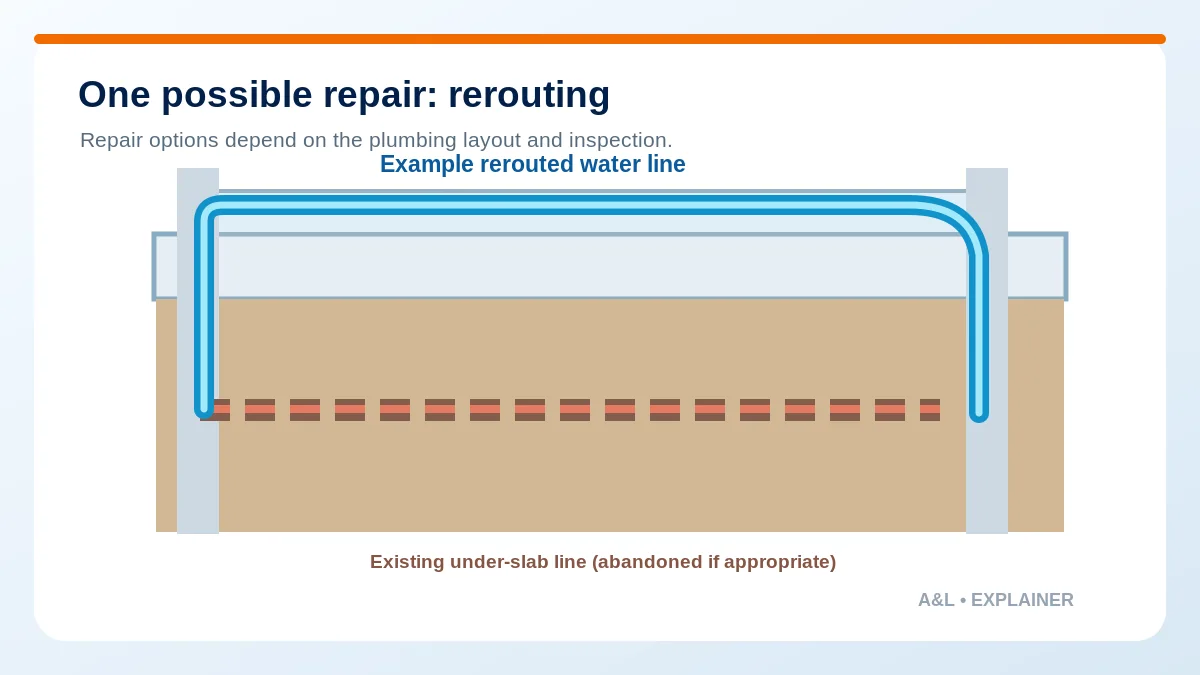
The failed line is abandoned in place and a new line is run above the slab, through walls or the attic. No concrete comes out beyond what is needed at the two ends. This is usually the right call when the break is in an awkward spot or under something that cannot be moved.
Repipe
The whole supply system is replaced. This is the answer when a house has already had two or three slab leaks, because the fourth one is coming. Paying to chase individual pinholes in a fifty-year-old system costs more over five years than replacing it once.
Which of the three is right depends on the age of the house, how many failures it has had, and where the break sits. That decision should be made after the leak is located, not before.
When to stop and call
Call the same day if any of these are true:
- The meter dial moves with every fixture in the house closed
- There is a warm spot on the floor
- You can hear water running at night with nothing on
- Baseboards, carpet or drywall near the floor are damp
- New cracks have opened in tile or along a wall
An active pressurized leak can worsen if left unaddressed. It erodes the ground under the floor and it keeps billing you for water you never used. The expensive version of this problem is the one that ran for six months, not the one that got located in week one.
Our services